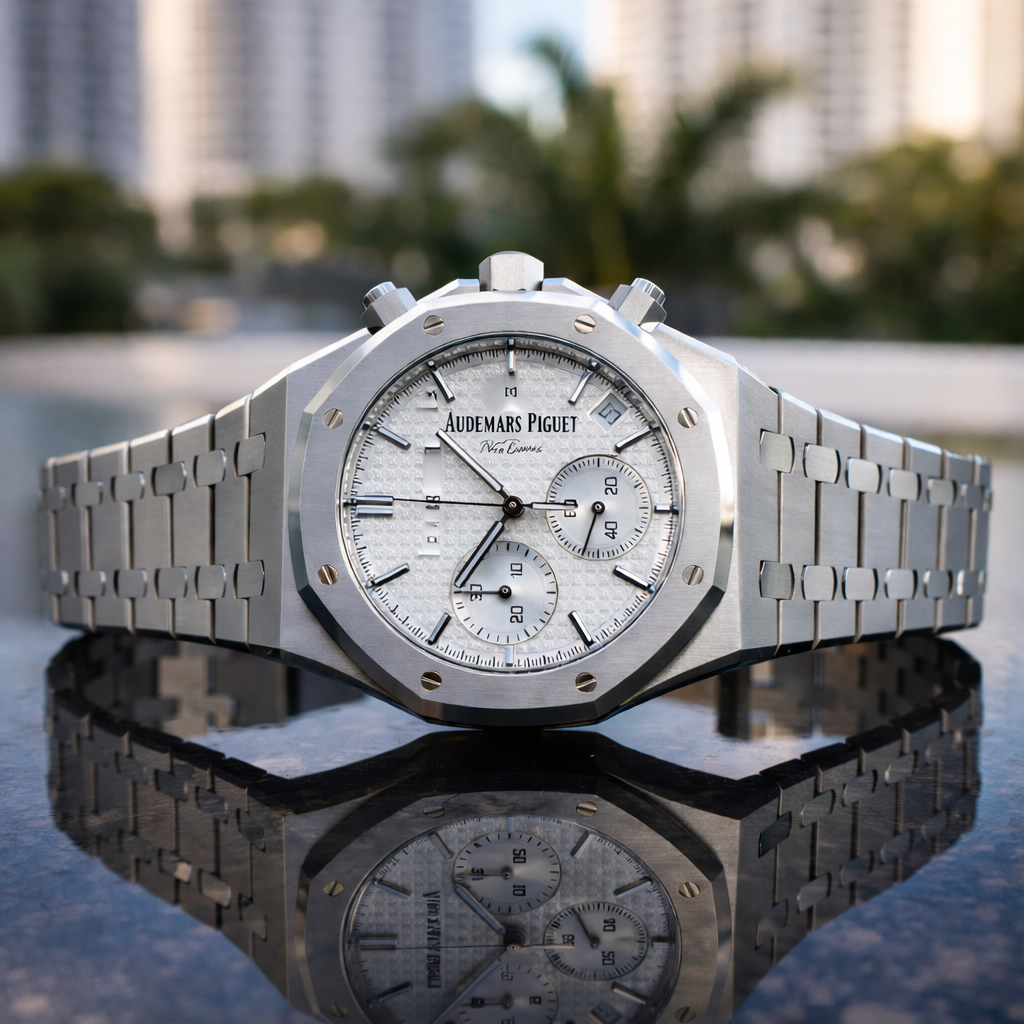
Audemars Piguet watches are finished to extremely tight tolerances—particularly across the case geometry, bracelet articulation, and movement components. The manufacture’s own guidance focuses on a simple philosophy: regular check-ups, correct handling, and controlled maintenance preserve both performance and aesthetics over time.
Periodical Check-Ups: The “Every Year” Rule
Audemars Piguet recommends an annual check-up covering four key areas:
- Chronometric performance (timekeeping accuracy)
- Functions (setting, calendar indications, etc.)
- Water-resistance state
- Magnetisation
AP notes that this yearly check-up is free of charge in all Audemars Piguet boutiques, and that when these check-ups are done regularly—and the care tips are followed—no further servicing should be necessary.
Prestige takeaway: This is a very “manufacture” way of thinking—preventive annual oversight, rather than reactive repairs.
Magnetic Fields: Modern Life, Real Risk
Audemars Piguet explicitly warns that everyday magnetic fields can interfere with movement performance, and that a simple demagnetisation can be performed in AP boutiques.
Best practice (AP-aligned):
- Treat magnetism as a yearly checkpoint, not a one-time concern.
- If you notice sudden irregular timekeeping, don’t “DIY” it—use the boutique demagnetisation route.
A Proper Fit: It’s Also a Mechanical Issue
AP stresses the watch should be properly fitted on your wrist to:
- Improve the efficiency of the winding system
- Avoid premature wear of bracelet links
They also advise avoiding multiple watches or jewelry on the same wrist to reduce scratching and link wear.
A Regular Winding: At Least Once a Month

This is one of the most important “missed details,” and you’re right to insist on it.
Audemars Piguet states:
For a selfwinding watch: AP recommends at least 30 turns of the crown to keep movement components well lubricated.
You should wind your mechanical watch at least once a month.
For a hand-wound watch: turn the crown until it resists, without forcing it.
Editorial interpretation (safe and accurate): even if you rotate watches and don’t wear an AP regularly, the manufacture still wants the movement periodically exercised.
Setting Time & Date: Avoid Afternoon and Evening
Audemars Piguet provides a very clear instruction many owners ignore:
Avoid adjusting the time or correcting the day, date, month, or lunar phases in the afternoon or evening.
For details, AP directs owners to the watch user manual (reference-specific).
Why it matters: calendar mechanisms are often in a transition phase later in the day; forcing corrections during engagement windows increases the risk of damage or misalignment.
Cleaning Your Watch: The Official Method
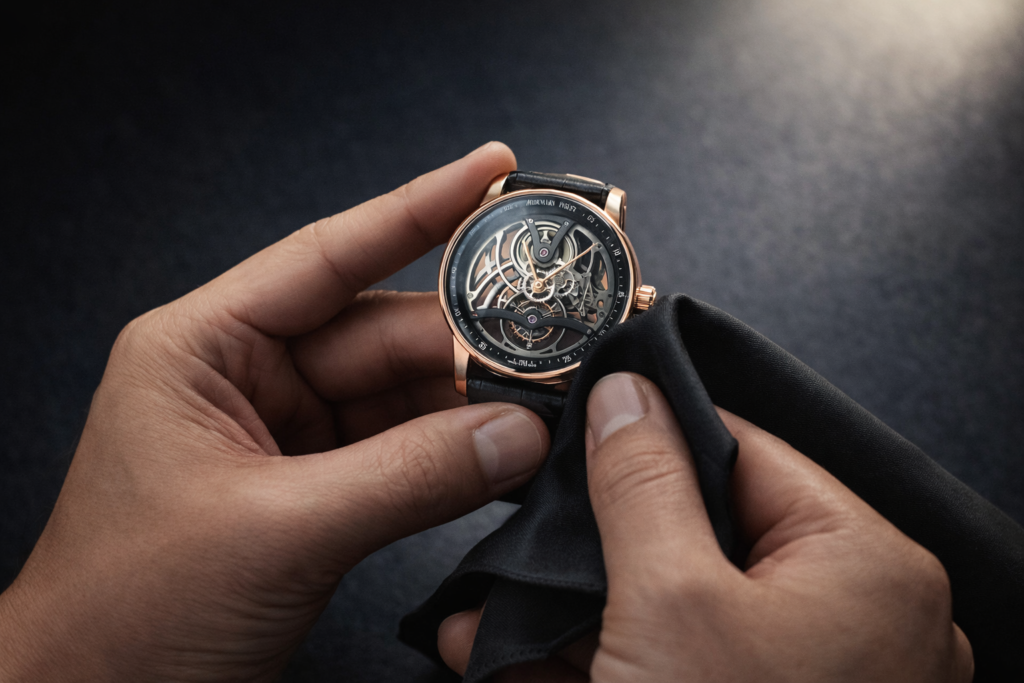
Audemars Piguet’s cleaning method is specific and practical:
- Clean the watch and its metal bracelet regularly with warm water
- Rinse with fresh water
- Dry with a soft cloth
- Avoid water contact for:
- non-water-resistant watches
- watches fitted with leather straps
This is a manufacturer-level cleaning protocol—simple, controlled, repeatable.
Water Resistance: Crown, Push-Pieces, and Saltwater Protocol
Before immersing your watch, AP instructs:
- Check that the crown and push-pieces are fully screwed down
- Aside from diver models, the crown and push-pieces should not be activated under water
- After swimming in salt water, rinse the watch with fresh water
Prestige note: This is the difference between “water resistant” as a rating and “water safe” as behavior. AP’s guidance is behavioral.
Leather Straps: Water Is the Enemy
AP is direct:
- Avoid contact with water for leather straps
- This caution does not apply to rubber straps or bracelets
That single line is worth keeping in your article—because it’s official, clear, and prevents expensive strap degradation.
Corrosive Environment: What to Do if Contact Happens
AP explicitly mentions corrosive materials (examples include acid, perfumes, carbonated beverages, etc.) that can damage water-resistant seals. Their instruction:
- If contact occurs, clean your watch with fresh water as advised.
Editorial takeaway: this is a real-world luxury issue—perfume and beverages are common in daily life, and AP addresses it directly.
Polishing and Refurbishing: Limited, Controlled, Never Excessive
Audemars Piguet makes an important collector-grade point:
- Polishing/refurbishing can be requested when a complete maintenance service is needed
- It should only be done a limited number of times
- Polishing will not fully prevent natural patina that comes with time
Prestige Royals framing: finishing is value. Over-polishing can soften edges and reduce originality—AP’s wording supports that without sounding alarmist.
For more detailed, reference-specific recommendations, visit Audemars Piguet’s official care page: