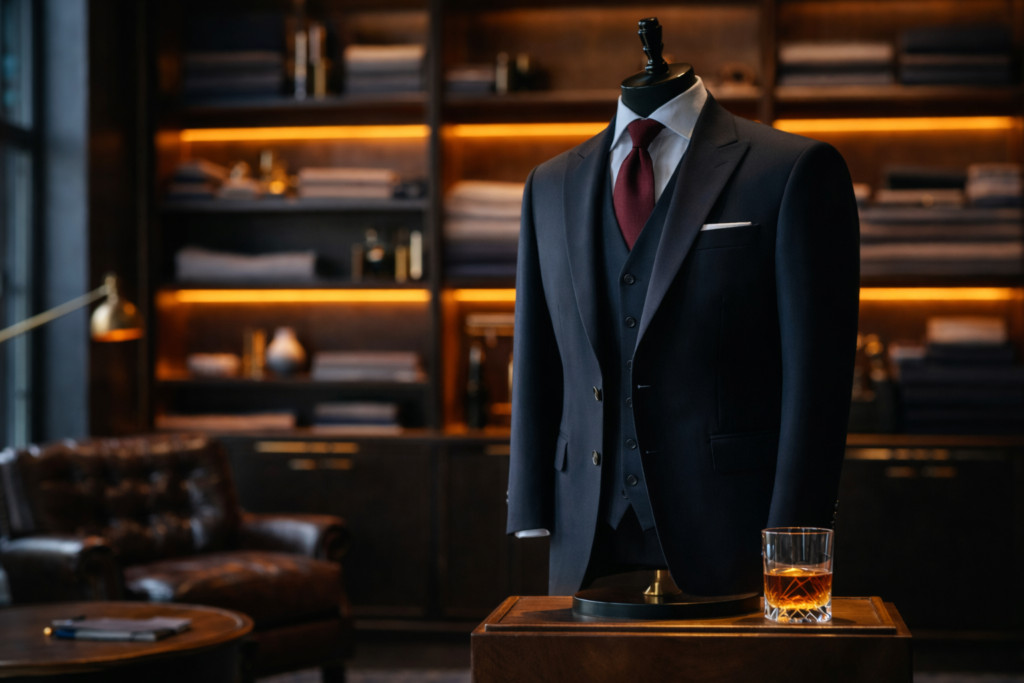
In a cultural moment preoccupied with speed, minimal contact, and digital everything, the quiet return of bespoke tailoring signals a striking countermovement. No longer reserved solely for Savile Row loyalists or heritage connoisseurs, handcrafted garments are being re-embraced by a new generation of affluent consumers seeking meaning, precision, and privacy in how they dress. At the top end of the market, the bespoke suit has become less about display and far more about discretion. This is the new silhouette of quiet luxury.
The Return of the Individual
Bespoke tailoring has outlasted countless fashion cycles. Yet in recent years, its resurgence is not merely a response to nostalgia, but rather a rejection of homogenization. According to market observers, demand for made-to-measure and fully bespoke garments has grown steadily among discerning clientele—particularly those in wealth hubs such as London, New York, Singapore and Dubai. These are clients who no longer equate luxury with logos, but with the rare privilege of owning something that exists only for them.
Personalization has become the core currency of modern affluence. From the fall of mass luxury to the rise of atelier-driven design, tailored fashion is increasingly viewed not simply as clothing, but as a declaration of intent. Commissioning a bespoke piece offers more than fit; it delivers presence, integrity, and a convenant between maker and wearer. In an age when uniqueness is algorithmically undermined, the bespoke suit remains distinctly human.
Legacy Houses and Emerging Artisans
While institutions like Huntsman, Cifonelli, and Rubinacci continue to lead the conversation in traditional menswear, new ateliers are redefining what bespoke can be. Younger tailors across Europe and Asia are blending heritage construction with contemporary silhouettes, producing garments that appeal beyond old-world aristocracy.
There is also rising attention on sustainability. Unlike mass-market clothing, bespoke eliminates unnecessary inventory and embodies traceable sourcing. As high-net-worth individuals become more discerning about ethical production, tailors who can trace their fabric mills, handwork, and supply lineage are valued not only for style, but for substance. In some circles, that’s the new exclusivity—an informed, almost scholarly ownership of clothing as craft.
Luxury Repositioned: Bespoke in the Age of Stealth Wealth
Industry analysts note a broader trend shaping this cultural return: stealth wealth. Last season’s digitally born maximalism has given way to tactile understatement. This has reshaped sartorial priorities. Instead of seasonal reinvention, today’s elite increasingly favour longevity and fluency—garments constructed to endure decades, not quarters.
In this context, bespoke tailoring acts as an antidote to fast fashion and algorithmic style. A hand-padded lapel or floating canvas interior represents time, patience and profound sartorial knowledge—qualities that cannot be packaged. These garments do not shout; they whisper fluency, an inner confidence that transcends trend. The most important names are often the ones sewn inside.
Women’s Bespoke: A Segment Expanding with Purpose
Historically male-dominated, the bespoke world is finally seeing momentum in women’s tailoring. Atelier-focused brands such as The Deck in London and Maison Lemarié in Paris have carved out a new language for precision womenswear—one that borrows from classic tailoring while acknowledging feminine form and identity.
This shift is not a trend play. It reflects broader social and economic shifts, with powerful women now demanding the same level of sartorial authority long reserved for men. And with customization at the heart of heritage craftsmanship, women’s bespoke is no longer peripheral—it is pivotal to tailoring’s future relevance and growth.
The Experience as Luxury
The bespoke process is laborious by design. Measurements are taken over multiple sessions; fittings are refined with obsessive specificity. Cloths must be selected from heritage mills. Sleeves are aligned with shoulder pitch. The final result—often weeks or months in the making—is not just a suit, but a sartorial legacy, built one stitch at a time.
For the world’s most discerning clients, this experience forms part of the luxury itself. It is ritual as much as retail, a return to slowness and intimacy. Whether stepping into Edward Sexton’s Mayfair showroom or engaging with a sixth-generation Neapolitan tailor, this is a form of fashion that resists immediacy. It offers sanctuary from the noise of contemporary clothing culture.
What Bespoke Represents Now
Bespoke tailoring was never just about fabric or fit. It is a philosophical proposition—one grounded in discipline, culture, and often, generational continuity. For those seeking something beyond display, its value lies not in what is worn, but how, and why.
In this era of algorithm-driven sameness, true craftsmanship signals defiance. Worn quietly by billionaires, collectors, founders, and artists alike, bespoke clothing has reclaimed relevance in a moment that increasingly values intention over impression. As markets evolve and style is redefined by discretion, tailoring is once again at the center of sartorial excellence—measured not by spectacle, but by sincerity.
The modern wardrobe may embrace silhouettes of all kinds, but in the world of rarefied fashion, nothing embodies enduring luxury quite like clothing made by hand, made to measure, and made for one.