Private art clubs are reasserting their position not just as venues for elite socialization, but as influential nodes within the global art economy. As international demand for fine art grows—particularly at the intersection of culture, capital, and connoisseurship—these elusive spaces offer a discreet sanctuary for serious collectors, dealers, and cultural investors navigating an increasingly speculative marketplace.
The Discreet Revival of the Art Salon
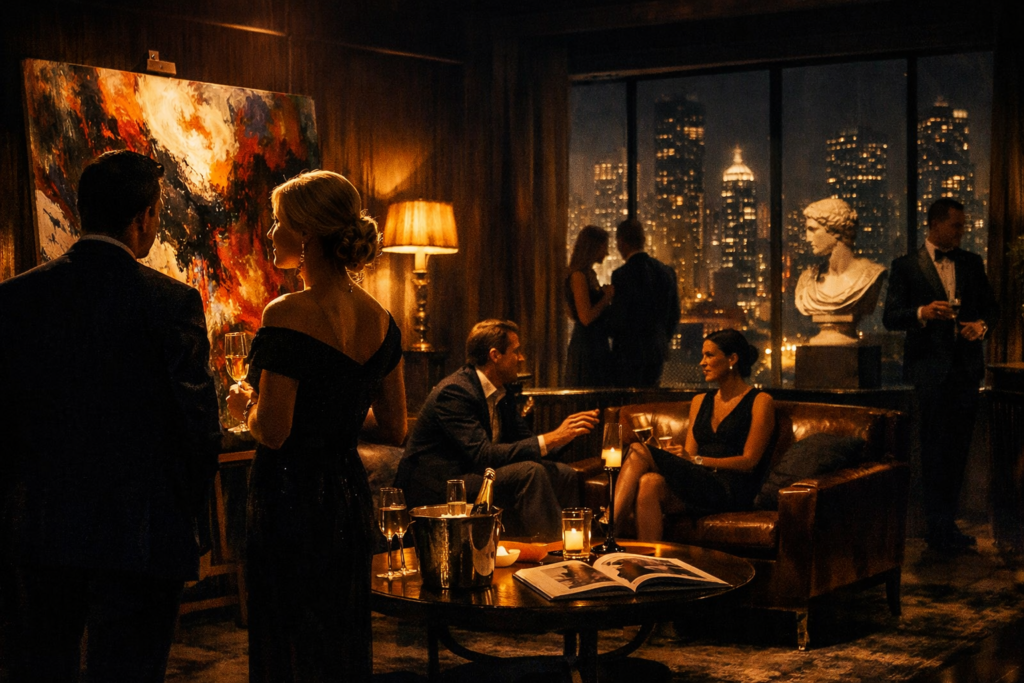
Once the domain of aristocratic salons and institutional back rooms, the contemporary private art club blends historic concept with modern discretion. Establishments such as The Arts Club in London or NeueHouse in New York have redesigned the template: curated interiors, by-invitation programs, and private viewing rooms now sit alongside Michelin-level culinary programming and members-only art fairs.
Industry observers note that this resurgence is driven by more than aesthetics or social cachet. As art becomes an increasingly financialized asset class, these clubs offer privileged access to emerging markets, primary works, and insider intelligence before open release. Trust—not just liquidity—forms the currency of these rarefied networks.
Connoisseurship Over Visibility
For many collectors, public exhibition no longer serves as the primary axis of cultural capital. In the world of rare multimillion-dollar pieces and under-the-radar artists, visibility can be counterproductive. The appeal lies in privacy, stewardship, and direct connection with creators—the very elements these clubs are structured to support.
According to recent market reports, high-net-worth individuals increasingly prefer acquisitions through trusted curators and private viewings, rather than public auctions. Private art clubs cater precisely to this shift—offering confidential access to rotating inventories, secure transaction environments, and vetted peer introductions without broker interference.
Strategic Investment in an Intangible World
Market dynamics suggest that fine art is fast aligning itself with alternative investment categories, appealing to collectors seeking long-term value with low correlation to traditional equities. But tangible assets like painting and sculpture present storage, provenance, and authenticity challenges. Here, private clubs often serve dual purposes: social platform and gatekeeper for secure transactions.
Some offer on-site vaults and climate-controlled storage. Others provide access to advisors who track valuation indices, advise on estate implications, and connect collectors directly with artists or blue-chip dealers. The goal is not just ownership, but strategic acquisition—often with generational perspective.
Memberships That Signal More Than Taste
Joining a private art club involves more than fees and references—it requires alignment with the institution’s curatorial and intellectual ethos. In this sense, these clubs operate almost as cultural trusts. Members become stewards of aesthetics and ideas, responsible for preserving dialogue in a world increasingly defined by algorithmic consumption and fleeting digital attention.
While some clubs operate on a legacy model involving nominations and waiting lists, others now curate membership through panels of artists, scholars, and major patrons. Selection, in many cases, is thematic—allowing the club to maintain dialogue around particular movements, regions, or philosophies in contemporary art.
Global Networks, Local Voices
Despite their exclusivity, most private art clubs maintain a distinctly local sensibility. The programming often centers around regional artists, independent galleries, and cultural institutions, even while connecting into broader networks of patrons, critics, and curators. This fusion allows a Seoul-based collector to gain early access to a Mexico City artist or a Middle Eastern patron to host a New York-debut preview—a fluidity previously reserved for institutional elites.
Temporary residencies, transcontinental satellite locations, and rotating curatorial teams all contribute to this hybrid model. For globally mobile members, this ensures a continuum of access and cultural immersion regardless of geography.
Evolving Club Models for a Quietly Digital Age
While the digital art world continues to evolve—with NFTs, virtual exhibitions, and blockchain-driven provenance—the private art club remains resolutely analog in its core values. However, the most forward-thinking clubs are integrating technology with restraint: secure digital catalogs for members only, AI-enhanced valuation tools, and encrypted communication platforms for private deals.
This approach allows for enhanced discretion without surrendering to public market volatility. As elite collectors seek ever more personalized, discerning experiences, digital augmentation is seen not as transformation, but refinement. High bandwidth, low noise—reflecting the nature of the collections themselves.
The return of private art clubs reflects a fundamental truth about modern collecting: that in a market crowded with eyes, true value lies in what remains unseen. They are not simply status symbols or social enclaves, but purposeful ecosystems for those who view art not as commodity, but as legacy.