The global demand for Audemars Piguet watches—particularly Royal Oak and Royal Oak Offshore models—has made the brand one of the most counterfeited in high-end watchmaking. Modern replicas can appear convincing at first glance, making traditional “visual checks” increasingly unreliable.
Audemars Piguet’s own position is clear: authenticity is verified through documentation, serial identification, and authorized inspection—not guesswork. This guide outlines the correct, manufacture-aligned approach to confirming whether an Audemars Piguet is genuine.
In short, to spot a fake Audemars Piguet (AP), check for perfect finishing, crisp engravings, and an almost silent second hand, as fakes often have rough edges, blurry logos, audible ticking, lighter weight, misaligned bezel screws (Royal Oak), or poor internal movements. Always verify the unique serial number against official documentation and purchase from trusted, authorized dealers, as price and seller reputation are major red flags for counterfeit
Key Indicators to Inspect:
- Build & Finish:
- Weight: Real APs are substantial; fakes feel light due to cheap metals.
- Edges & Surfaces: Look for smooth, flawless finishes; fakes have rough edges or uneven polishing.
- Bezel Screws (Royal Oak): Screws should be perfectly aligned and flush, not over-filled or misaligned.
- Bracelet/Links: Links should sit flush; gaps or poor fit signal a fake
One of the easiest ways to spot the difference between a genuine and counterfeit Audemars Piguet watch is by how it feels in the hand. Authentic Audemars Piguet timepieces are made from high-grade materials such as stainless steel, gold, platinum, and titanium, giving them a solid, well-balanced weight. Fake watches are usually produced with inferior metals, making them feel noticeably lighter and less robust.
Another key distinction lies in the craftsmanship. Real Audemars Piguet watches are finished to an exceptionally high standard. The case, bracelet, and dial should look flawless, with smooth surfaces, sharp edges, and precise engravings. Counterfeit models often reveal themselves through rough finishing, uneven brushing or polishing, and poorly executed engravings that lack refinement.
Most Audemars Piguet watches feature luminous hands or hour markers for visibility in low-light conditions. On an authentic piece, the lume is evenly applied, bright, and long-lasting. In contrast, fake watches often use weak or inconsistent lume that fades quickly. When viewed in darkness, the difference in brightness and duration is usually obvious.
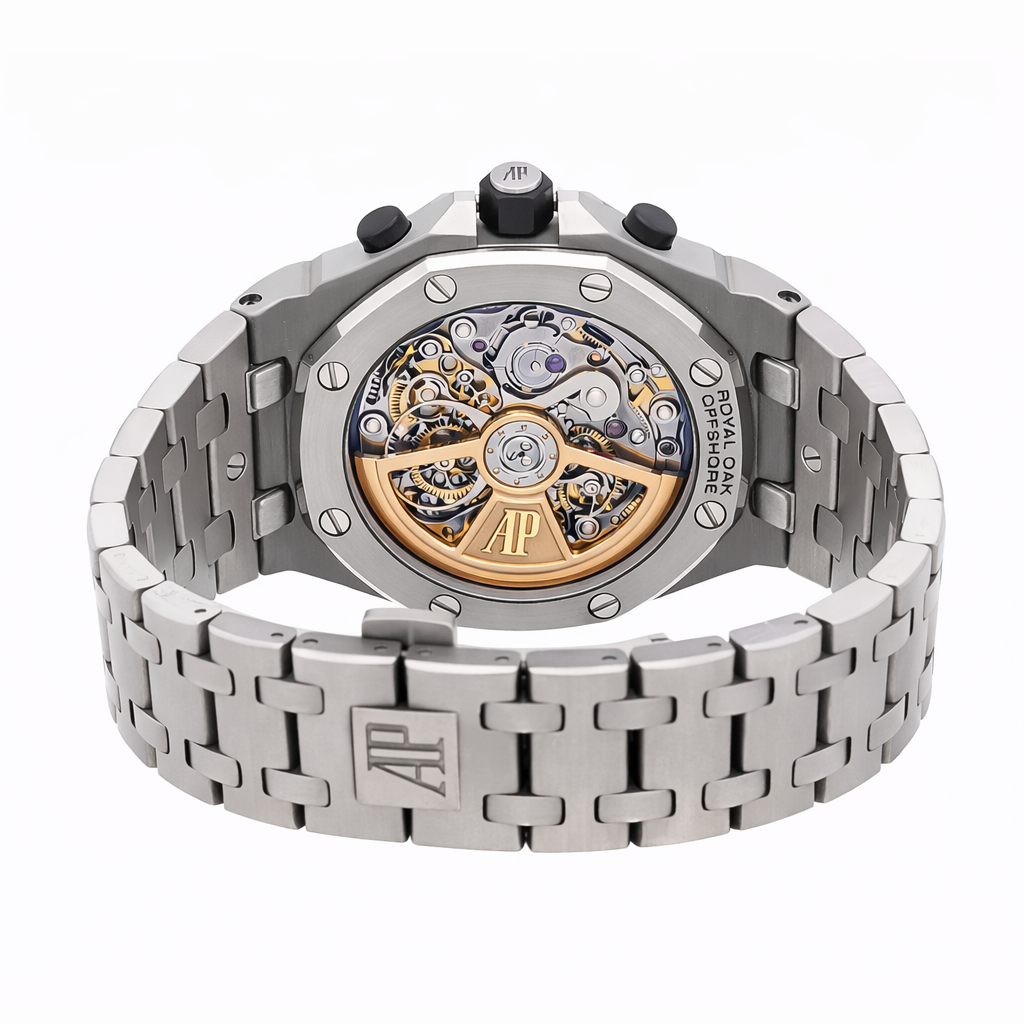
One of the most important elements of any Audemars Piguet watch is the movement. As a prestigious Swiss manufacture, the brand produces its own highly complex mechanical movements, known for their precision, reliability, and visual beauty. Many models allow the movement to be viewed through a transparent caseback.
Counterfeit watches typically contain inexpensive quartz movements or basic automatic mechanisms that lack sophistication. A simple way to notice the difference is by observing the seconds hand. On a genuine automatic Audemars Piguet, it moves smoothly across the dial, while on a fake—especially one powered by quartz—it often ticks in noticeable jumps.
Examining the dial closely can also reveal important clues. Authentic dials are meticulously detailed, including the finely executed “Tapisserie” pattern commonly seen on Royal Oak models. This pattern appears crisp, uniform, and precisely machined. On fake watches, the pattern is often printed or poorly formed, lacking depth and consistency.
The logo and text on a real Audemars Piguet dial are perfectly aligned, sharply defined, and cleanly engraved or applied. Counterfeit watches may show misaligned text, blurred printing, or incorrect fonts that differ from the original design.
Start with the Documents: What Really Matters
An authentic Audemars Piguet is delivered with official documentation issued at the time of sale. These documents link the watch to its reference and serial numbers and serve as the primary proof of origin.
While documentation alone does not guarantee authenticity, its absence should immediately prompt caution—particularly in the secondary market.
Service Records and Official History
Audemars Piguet emphasizes the importance of traceable service history. Watches serviced through official channels are logged within the brand’s internal systems, creating a verifiable record over time.
Claims such as “recently serviced” should always be supported by documentation from an Official Audemars Piguet Service Center or Boutique.
Serial Numbers: Why DIY Checks Fall Short
Every Audemars Piguet watch carries unique identification numbers. However, the manufacture does not recommend owners or buyers attempt to verify these independently.
Why?
- Accessing movement numbers often requires opening the case
- Improper opening risks damaging the watch
- Counterfeiters frequently reuse legitimate serials
Audemars Piguet’s guidance is explicit: case opening and serial verification must be performed by authorized professionals. Any seller unwilling to allow this step should be treated with skepticism.
Every authentic Audemars Piguet watch carries a unique serial number engraved into the case, which matches the official documentation. Fake watches may be missing a serial number altogether or feature one that is shallow, uneven, or incorrect. Genuine pieces are also delivered with official warranty cards, certificates of authenticity, and high-quality presentation boxes.
To confirm authenticity, the serial number should always be verified through Audemars Piguet or an authorised retailer. Counterfeit watches often come with fake paperwork or no documentation at all.
The caseback is another important detail. Many genuine Audemars Piguet watches—especially Royal Oak models—feature a transparent caseback that reveals the finely finished movement inside, complete with brand engravings and serial markings. On fake watches, the caseback may be solid, poorly made, or, if transparent, reveal a low-quality movement with minimal decoration.
Finally, pay close attention to the bezel screws on models like the Royal Oak. On an authentic Audemars Piguet, these screws are perfectly aligned and sit flush with the surface. On counterfeit versions, screws are often misaligned, uneven, or poorly fitted, detracting from the overall appearance and quality of the watch.
Authorized Inspection: The Only Reliable Verification
The most reliable way to authenticate an Audemars Piguet is through:
- An Official Audemars Piguet Boutique
- An Authorized Service Center
These locations can:
- Inspect the movement, case, and finishing
- Verify serials against manufacture records
- Confirm originality of components
This process goes far beyond visual inspection and eliminates uncertainty created by high-grade replicas.
Why Visual “Fake Checks” Are No Longer Enough
Many online guides focus on:
- Logo alignment
- Dial typography
- Case finishing details
While these elements may reveal poor counterfeits, they are increasingly ineffective against modern replicas that replicate external aesthetics with remarkable accuracy.
Audemars Piguet’s position avoids this trap entirely: external appearance alone is not a reliable indicator of authenticity.
Pricing and Provenance: Context Still Matters
Although not a definitive test, price and provenance remain important signals:
- Significantly under-market pricing often indicates elevated risk
- Vague seller histories or pressure to complete a transaction quickly should raise concern
When combined with missing documentation or refusal of authorized inspection, these factors strongly suggest caution.
The Role of Authorized Service in Value Preservation
Beyond authentication, Audemars Piguet stresses that authorized service preserves:
- Mechanical integrity
- Case and bracelet geometry
- Long-term resale value
Even a genuine watch can lose value if it has been altered or serviced outside approved channels. Authentication, therefore, is not only about legitimacy—it is about preserving originality.
A Manufacture-Aligned Mindset
Audemars Piguet does not encourage owners to become counterfeit experts. Instead, it provides a clear framework:
- Trust documentation
- Verify through authorized channels
- Avoid unnecessary handling or inspection
This approach reflects the manufacture’s broader philosophy: precision is safeguarded through expertise, not improvisation.
Final Word: When in Doubt, Walk Away
The most important guidance is also the simplest. If a seller:
- Cannot provide credible documentation
- Refuses authorized inspection
- Relies solely on visual reassurance
The safest option is to walk away. Authentic Audemars Piguet watches withstand scrutiny—counterfeits rely on urgency and uncertainty.
Further Reading: Official Audemars Piguet Care & Service
For information on authorized service, inspection, and ownership responsibilities, consult the manufacture directly: