
Omega designs its watches to perform reliably in demanding environments—from deep-sea exploration to spaceflight. Yet even the most robust Omega timepiece relies on correct winding, careful setting, and disciplined crown handling to maintain long-term accuracy and durability.
This guide outlines Omega’s official best practices for winding and setting modern mechanical watches, including Co-Axial and Master Chronometer models.
Identify Your Omega Movement Before You Begin
Omega produces three primary movement types:
- Manual-winding mechanical
- Self-winding (automatic) mechanical
- Quartz
Most contemporary Omega models feature self-winding Co-Axial movements, many of which are Master Chronometer certified. While crown positions vary slightly by model and complication, the fundamental principles of winding and setting remain consistent.
For advanced complications, Omega always recommends consulting the reference-specific instructions.
How Often You Should Wind an Omega Watch
Omega advises that mechanical watches should be wound regularly, even when not worn daily.
For collectors who rotate watches:
- A stopped mechanical Omega should be wound before setting and wearing
- Periodic winding helps keep lubricants evenly distributed within the movement
This guidance applies to both manual and self-winding models.
How to Wind a Manual-Winding Omega
For manual-winding Omega watches such as certain Speedmaster Professional models:
- Ensure the crown is in the winding position
- Turn the crown slowly and smoothly
- Stop winding as soon as resistance is felt
- Never force the crown beyond resistance
Omega movements are engineered with precision tolerances. Gentle, controlled winding protects the mainspring and internal gearing.
How to Wind a Self-Winding (Automatic) Omega
Self-winding Omega watches are powered primarily by wrist motion. However, Omega recommends manual winding when the watch has stopped.
Best practice:
- Wind the crown approximately 20–40 turns
- This ensures sufficient initial power before normal wear resumes
- Always set the time by moving hands forward, past 12, to avoid date issues, then re-screw the crown to maintain water resistance.
Once worn regularly, the movement will maintain its power reserve automatically.
Setting the Time with Precision
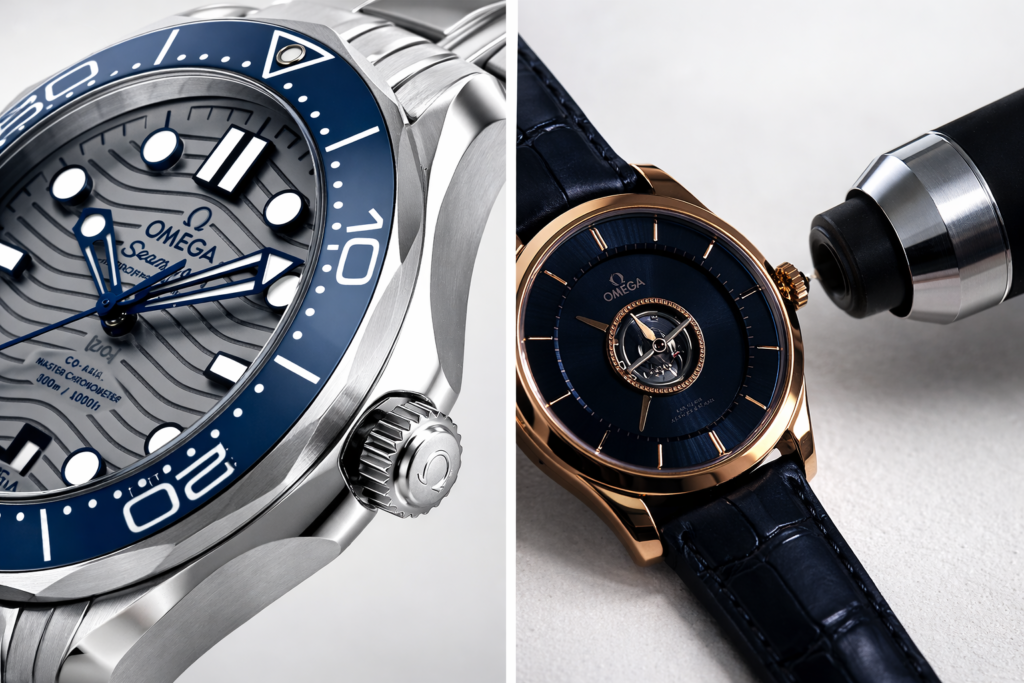
To set the time:
- Pull the crown gently to the time-setting position
- Adjust the hands smoothly to the correct time
- Avoid rapid back-and-forth movements
Many Omega movements stop the seconds hand during time setting, allowing for precise synchronization.
After setting, always return the crown to its fully closed or screwed-down position, depending on the model.
Setting the Date and Calendar Functions
Omega advises caution when adjusting date or calendar indications.
General guidance:
- Avoid changing the date when the mechanism is engaged, typically during the late evening and early morning hours
- Use only the designated crown position for date correction
For watches with advanced calendar complications, follow the model-specific instructions provided by Omega to prevent damage.
Screw-Down Crowns: A Critical Habit
Many Omega watches, particularly Seamaster models, feature screw-down crowns.
Correct handling:
- Unscrew the crown fully before winding or setting
- After adjustment, screw the crown back down gently but securely
- Never force the threads
This practice is essential to maintaining water resistance and protecting the case seals.
When Not to Adjust Your Omega Watch
Omega recommends avoiding:
- Crown operation while the watch is wet or submerged
- Adjustments during restricted calendar hours
- Repeated corrections to compensate for perceived inaccuracy
If timekeeping irregularities occur, Omega advises inspection by an authorized service center rather than excessive manual adjustment.
Precision Is Maintained Through Consistency
Winding and setting an Omega watch should be deliberate and unhurried. Omega’s engineering philosophy favors regular, gentle interaction over infrequent, aggressive handling.
By winding stopped watches before wear, respecting crown discipline, and following official setting guidance, owners ensure that their Omega continues to perform as designed—accurately, reliably, and for decades to come.
Further Reading: Official Omega Instructions
For reference-specific crown positions, complication handling, and official guidance, consult Omega directly: