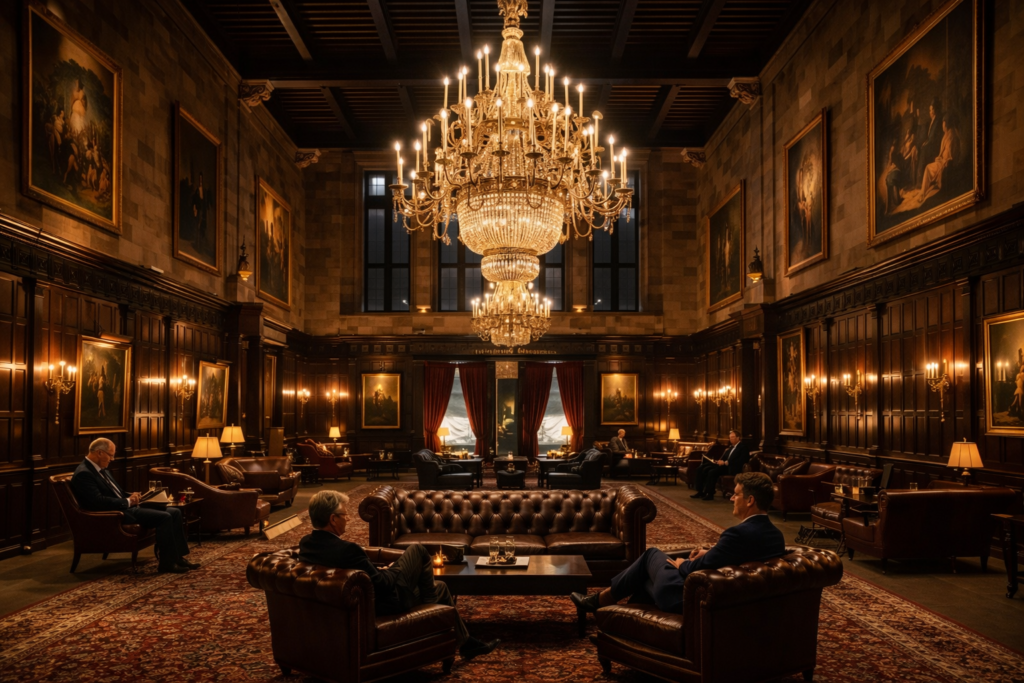
In the escalating pursuit of distinction, ultra-private membership clubs have reasserted their relevance at the pinnacle of the luxury sphere. Once the guarded playgrounds of political elites and aristocrats, today’s incarnations are meticulously designed enclaves servicing entrepreneurs, cultural tastemakers, and next-generation global wealth. Far from ostentation, their value lies in curation: of space, of experience, and above all, of access.
The New Geography of Privilege
Private members clubs are no longer confined to London’s Mayfair or New York’s Upper East Side. From discreet boltholes in Kyoto to restored villas in the Umbrian hills, these establishments have evolved into global passports of belonging. Their reach has extended beyond traditional financial capitals to include regional epicenters of emerging wealth and influence—from Singapore to Nairobi, São Paulo to Riyadh. According to market observers, this geographic expansion mirrors the fluidity of today’s elite lifestyle, where cross-border commuting is both cultural and commercial.
In these destination outposts, exclusivity is shaped more by alignment of values than by postcode or accent. Sustainability, cultural diplomacy, and intellectual programming are increasingly at the forefront, supplanting legacy status symbols with meaningful engagement.
Modern Prestige, Quietly Tailored
While legacy institutions such as White’s and Annabel’s maintain an irreproducible heritage stamp, newer entrants like Core: Club in New York or The Aster in Los Angeles cater to a clientele more fluid in identity, discerning in experience, and international in scope. Their architectural expression tends to eschew grandeur in favor of subtle materiality—brushed brass, reclaimed stone, hand-finished woods—creating a sense of privacy over pomp.
This softer, more intuitive design ethos extends to hospitality. Members no longer tolerate generic luxury. Instead, they expect wellness menus crafted by naturopaths, wine cellars curated by biodynamic vintners, and events facilitated by global thought leaders. As industry analysts note, personalization is no longer a service add-on; it is the foundation of member retention.
Gatekeeping and the Affluent Psychology
These clubs are defined as much by whom they exclude as whom they admit. Entry protocols remain rigorous, even if modernized. Financial prerequisites often run parallel with cultural literacy, entrepreneurial contribution, or artistic patronage. For example, Stockholm’s Ett Hem—a 12-room townhouse attracting both design insiders and creatives—requires neither application forms nor advertising. Instead, it builds membership through deliberate connection and word-of-mouth prestige.
This discreet vetting is not mere elitism. It reflects a deeper shift in how the global elite vet their communities: with an eye toward discretion, shared perspective, and curated serendipity. Increasingly, members seek not anonymity, but alignment.
Redefining the Business of Belonging
Financially, these clubs operate at the intersection of real estate, hospitality, and network capital. According to recent industry reports, the sector has experienced resilient growth, buoyed by the migration of professional life into nontraditional spaces. As high-net-worth individuals decouple their work schedules from fixed geographies, members clubs offer elegant continuity—offices dressed as salons, lounges embedded with high-speed connectivity.
Notably, digital membership tiers have emerged in leading clubs, responding to changing patterns of consumption and mobility. While physical entry may remain limited, platforms offering members-only panels, concierge services, and social access have expanded globally, echoing trends in luxury retail and remote-first business ecosystems.
The Next Iteration: Purpose over Prestige
Beyond aesthetics and access, the most forward-thinking clubs are recalibrating their raison d’être. They are shifting focus from exclusivity for its own sake to communities fostering intellectual and emotional capital. At London’s 180 House, conversation programming on climate futurism and cultural equity has begun to eclipse fashion dinners or tech panels in influence.
This new ethos resonates with a rising generation of wealth holders who view their membership less as status confirmation and more as ethical alignment. Philanthropic initiatives, sustainability pledges, and social impact labs are no longer peripheral perks—they are central pillars of the offering.
The contemporary private membership club does not simply promise refuge from the world. Increasingly, it offers a framework through which its members might meaningfully reengage with it—selectively, deliberately, and on their own terms.
Legacy Meets Modernity in a Changing Global Order
As the gap between noise and nuance widens, ultra-private clubs remain one of the few sanctuaries where solitude, discourse, and discernment coexist. They thrive not through mass proliferation, but through disciplined limitation. Each letter of invitation, each unmarked entryway, each whispered approval among peers reinforces a singular message: authenticity remains the final luxury.
In a world increasingly defined by velocity and exposure, these sanctuaries offer a considered counterpoint—quiet, inward-looking, and elegantly ahead of their time.